
Sources for Inver Grove Heights Past Residents
Previous residents are best traced as an address history with layers. Dakota County parcel and tax tools establish the present property reference. The recorded-land chain works backward by parties and legal description. Telephone directories and census releases can add a dated household layer, but neither is a complete list of every person at an address. City records, archival research, obituaries, and probate material can help explain a gap or a name change. The table separates the actual local coverage from sources that need more confirmation.
| Source | Years It Covers | Where Held | What It Shows |
|---|---|---|---|
| Dakota abstract deed index | Online from July 8, 1993 through the current index; status observed through August 2026 | RecordEASE and Dakota County Property Taxation & Records | Grantor, grantee, recorded-document trail, and legal-description links; account or payment applies |
| Dakota County tax statements | Current year plus three prior years online | Dakota County Property Taxation & Records | Ownership, legal and property address, tax detail, and special assessments |
| Dakota telephone directories | Inver Grove documented 1957-1964 and 1966-1989, with a 1965 gap | MNHS finding aid, print, and microfiche | Subscriber name, telephone, and address clues; unlisted households are absent |
| Federal census | Released person-level sequence through 1950 under the 72-year rule | NARA, libraries, and established genealogy access | Household clues that must be compared with the address trail |
| City and village records | 1909-1996 | MNHS finding aid and related archival material | Official actions, petitions, minutes, ordinances, and local-history context |
For a recent ownership question, begin with the property and deed layers. For a family or house-history question in the telephone-directory era, pair an address with nearby directory years and the census material that has been released. When the online route ends, the county counter, a written request, MNHS, and Dakota County Historical Society are documented alternatives.
Build Inver Grove Heights Past-Resident Dossier
Start a dossier before trying to name previous residents. Enter the street address or Parcel ID in Dakota County Property Information and retain the current address, Parcel ID, municipality, legal description, tax-roll owner, owner mailing address, and nearby subdivision or plat. The public property interface is address or Parcel ID keyed, not a verified owner-name search. Its selected parcel panels can show property, tax, and building information, but an owner mailing address is not proof that the owner lives at the property.
Use CityView’s property locator as a separate city check. It begins with a property-address autocomplete field or parcel number and can identify an existing city location. Permit applications and detailed application activity require sign-in, so it cannot be treated as a complete historic permit file. The tax-statement search adds the current and three prior years by house number or Property ID. Keep the access date beside every result, because portal data and processing status change.
- Property address
- The physical location used for a parcel or city record.
- Owner mailing address
- The tax-roll contact address, which may differ from the property address.
- Legal description
- The lot, block, subdivision, or other land description that ties an address to recorded documents.
- Parcel ID
- The county property identifier used to select a parcel and connect supporting property data.
Note: Preserve the property and mailing addresses separately because they answer different questions and can legitimately be different.
Trace Inver Grove Heights Past Records
After the dossier is complete, the land trail moves from the current owner and legal description to the purchase deed. Dakota County’s RecordEASE portal is the recorder index route. Its public login shows account registration and a payment path, but the post-login search fields and a sample deed result were not available for inspection. Do not assume a particular search menu or free image access. Once authorized to search, use the current owner and legal description to locate the purchase deed, then copy the indexed parties and document references exactly.
- Confirm the modern address, Parcel ID, municipality, legal description, owner, mailing address, and subdivision or plat in the dossier.
- Use the current owner and legal description in RecordEASE to locate the purchase deed or matching land-record reference.
- Record the grantor, grantee, recording date, document number, document type, available book-page or Torrens reference, and legal description.
- Take the seller, listed as the grantor on that deed, and search the seller as the next grantee to find the earlier acquisition.
- Repeat the grantor-to-next-grantee sequence, keeping spellings, initials, trust or entity names, and each legal description in the notes.
- Pause for a counter, mail, or office search when the online abstract trail reaches its documented boundary or a transfer is unclear.
- Grantor
- The party transferring an interest in a recorded document.
- Grantee
- The party receiving that interest. In a backward deed search, a prior seller is often the next person to seek as grantee.
- Chain of title
- The ordered sequence of transfers connecting a parcel through time.
- Legal description
- The land reference that remains useful when street-address wording changes or is incomplete.
RecordEASE displays the county’s index-coverage context and account gateway.
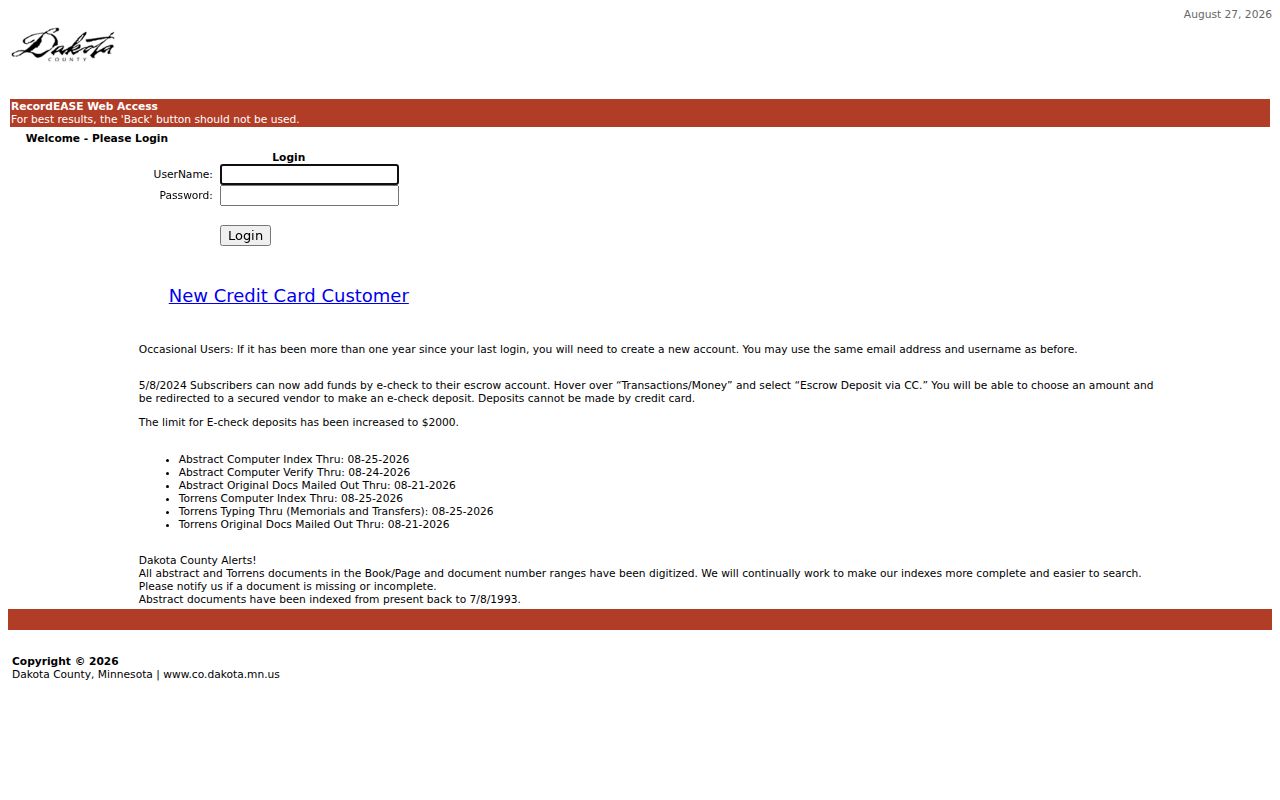
The account boundary is itself a useful research fact: a file may require county-assisted access rather than an assumed public online document search.
Inver Grove Heights Past Records in RecordEASE
Dakota County says abstract documents are indexed online from July 8, 1993. The recorded status observed on the login page ran through August 2026 for the relevant abstract and Torrens processing notices. The online index is therefore a strong starting point for the recent part of a deed chain, not a promise that earlier books or every image are equally available on the web. Abstract and Torrens material follow different systems, and a registered-land question can require the Dakota County Examiner of Titles.
Older records require a different channel: county counter research, deed book or book-page research, a recorded-document request by mail, or office assistance. Dakota County accepts written requests through Property Taxation & Records, Attn: Research, 1590 Highway 55, Hastings, MN 55033. The county advises calling 651-438-4597 for cost and allows about 24 hours. It also warns that private deed-copy solicitations can charge more than $90, so confirm a price with the county before paying a mailed offer.
Trusts, estates, divorces, foreclosures, Torrens memorials, and name variants can interrupt an apparent chain. That is a signal to compare a certified copy, probate file, county research result, or Examiner guidance, not to force a match. The land record may show a transfer without establishing every person who lived at the address.
Inver Grove Heights Past Records and Property Watch
Dakota County Property Watch runs in the opposite time direction from a deed-chain search. It offers a free alert signup by name, entity, or property, using an email address. A matched future recording alert can provide the party, recorded date, document number, and document type. It is helpful for watching future activity connected to a property or name, but it is not a replacement for the historical RecordEASE and county-records trail.
This split prevents a common error in previous-resident research. Use the parcel, legal description, and grantor-grantee sequence to reconstruct the past. Use Property Watch only to receive later recording alerts after enrollment. Common names can generate many matches, so compare every alert with the address dossier rather than connecting it to a parcel by name alone.
Property Watch’s official signup page documents its future-recording alert function.
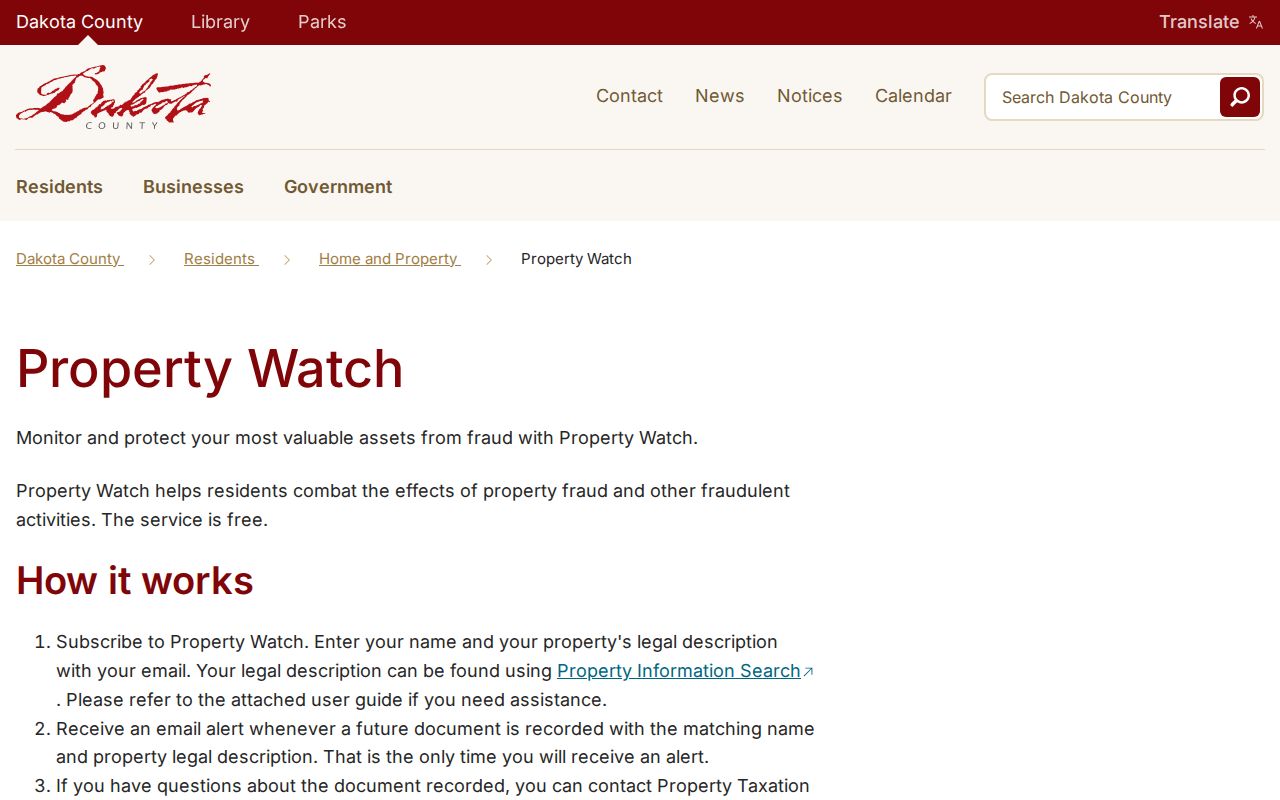
The future-facing alert is a useful supplement after a historical address dossier is already in place.
Pair Inver Grove Heights Past Residents and Census
Past residents leave a different kind of trail in the Minnesota Historical Society telephone-directory collection. The documented Inver Grove run is 1957-1964 and 1966-1989, with a 1965 collection gap and format changes in 1987-1989. Search the address or surname around the date in question, then try “Inver Grove,” “Invergrove,” township and village forms, and regional St. Paul South & West labels. The earlier regional series has documented gaps, so a blank result is a prompt to check a neighboring volume or another source.
Pair each directory clue with the released federal census sequence through 1950. A census can add household context, while a telephone listing usually identifies a subscriber and address. Neither source alone proves continuous residence or identifies every occupant. The collection detail, year runs, and entry limits are maintained with the Inver Grove Heights city directory collections, rather than repeated as a separate historical shelf here.
The MNHS Dakota telephone-directory finding aid identifies the local runs and formats used for this address layer.
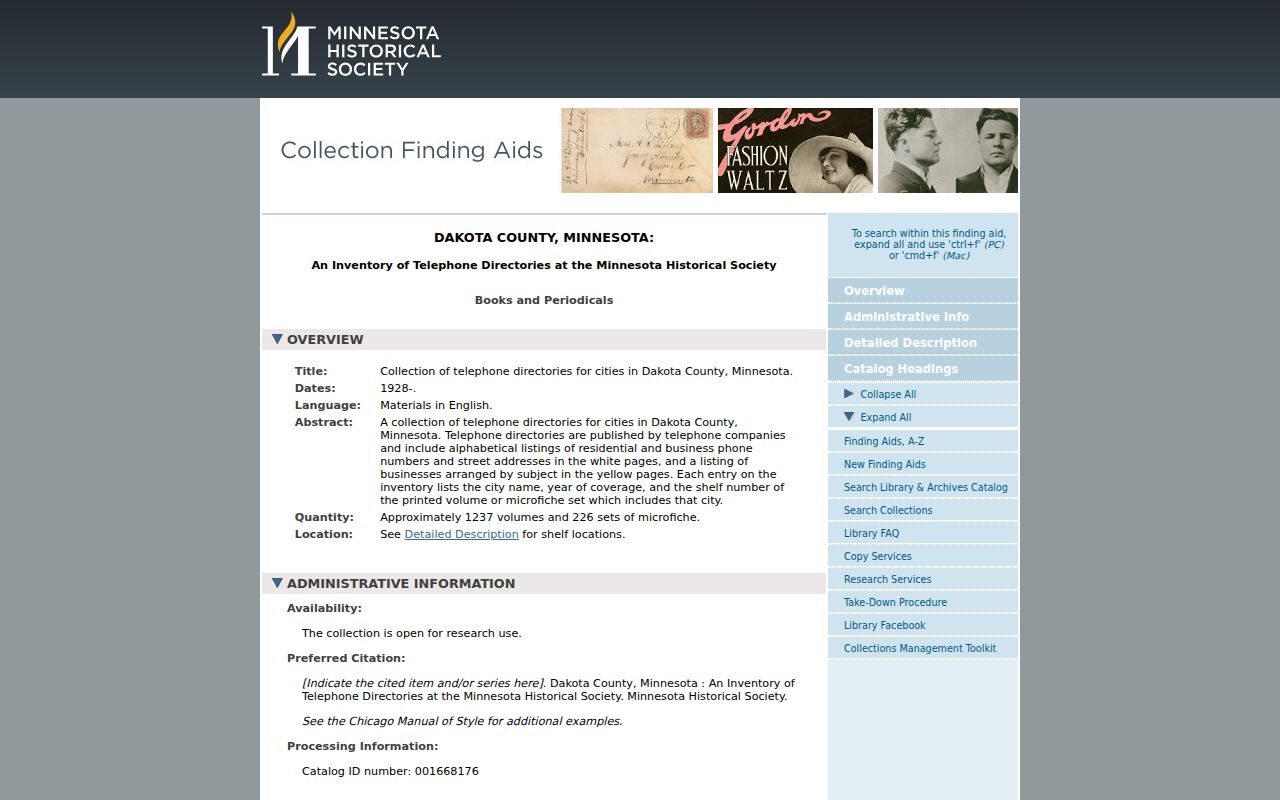
Use the cited collection description to choose a year and format before asking for a scan or microfiche access.
- Choose a directory year immediately before or after the target date and record the printed street address.
- Search the next available local year, then a regional title if the local series has a documented gap.
- Compare the address and names with the most relevant released census year through 1950.
- Test changes with tax, deed, obituary, cemetery, church, or newspaper records instead of assuming a continuous stay.
Inver Grove Heights Past-Resident Name Trails
A backward address search has to follow the city’s changing record geography. The official history places the township in 1858, the Village of Inver Grove in 1909, and the modern city in 1965, after more than 56 years of township and village coexistence. A historic name can therefore be a useful search term, not a typo. Look for Inver Grove, Invergrove, township, village, and regional labels when an address trail stops at a modern-city search.
The MNHS Inver Grove records finding aid describes city and village records from 1909-1996, including council minutes from 1909-1960, ordinances from 1910-1957, petitions, agreements, and resolutions from 1911-1964, plus histories from 1973-1996. These are not resident rolls. They can, however, bridge a plat name, street issue, official petition, or local event that helps place an address in the correct period.
The official city history supplies the township, village, and modern-city timeline used to widen an address search.
Inver Grove Heights Past Records and Sanborn Maps
Sanborn fire-insurance maps are often suggested for house history, but the reviewed MNHS Sanborn index did not verify an Inver Grove Heights sheet or year. The index’s broad 1867-1950 range is not evidence that the city has a sheet. Do not assign an unverified map date to a property or use a famous map series as proof of local coverage.
The appropriate next check is an MNHS, Library of Congress, or library-map catalog search using the historic locality variants. Until an actual catalog record or map image is opened, rely on the address dossier, plats, county map catalog, city and village records, directories, and the deed chain. That restraint avoids adding a false layer to a past-residents timeline.
Note: A missing verified map entry is a research result, so record the catalog searched and the locality names used.
Past Residents in Inver Grove Heights
Land transfers describe ownership history, not necessarily household history. For a later household clue, MNHS People Records has observed birth-index coverage from 1900-1934 and death-index coverage from 1904-2001. Obituaries, church and cemetery material, and probate files can add context, but they should be used as clues. A name in an obituary or index does not, by itself, prove continuous residence at the parcel.
No official Inver Grove Heights or Dakota County library house-history guide was located. The practical local alternative is the Dakota County Historical Society research service, combined with MNHS local-government and telephone-directory collections, Dakota GIS and tax statements, CityView, and the recorder trail. The Lawshe Memorial Museum/Research Library at 130 3rd Avenue North in South St. Paul offers research help for $15 per half-hour. Its stated phone is 651-552-7548, with hours Wednesday and Friday 9-5, Thursday 9-8, and Saturday 10-3.
When the records disagree, retain the source dates and uncertainty. A careful address history marks what a transfer, a phone listing, a census line, or an obituary actually supports, rather than merging them into a claim about every person who lived there before.